A Built4Life Lab researcher defends his PhD thesis on a national-scale UBEM, the third worldwide and the first fully automated and lightweight model
tech—inhabitāre
news details
actions
news content
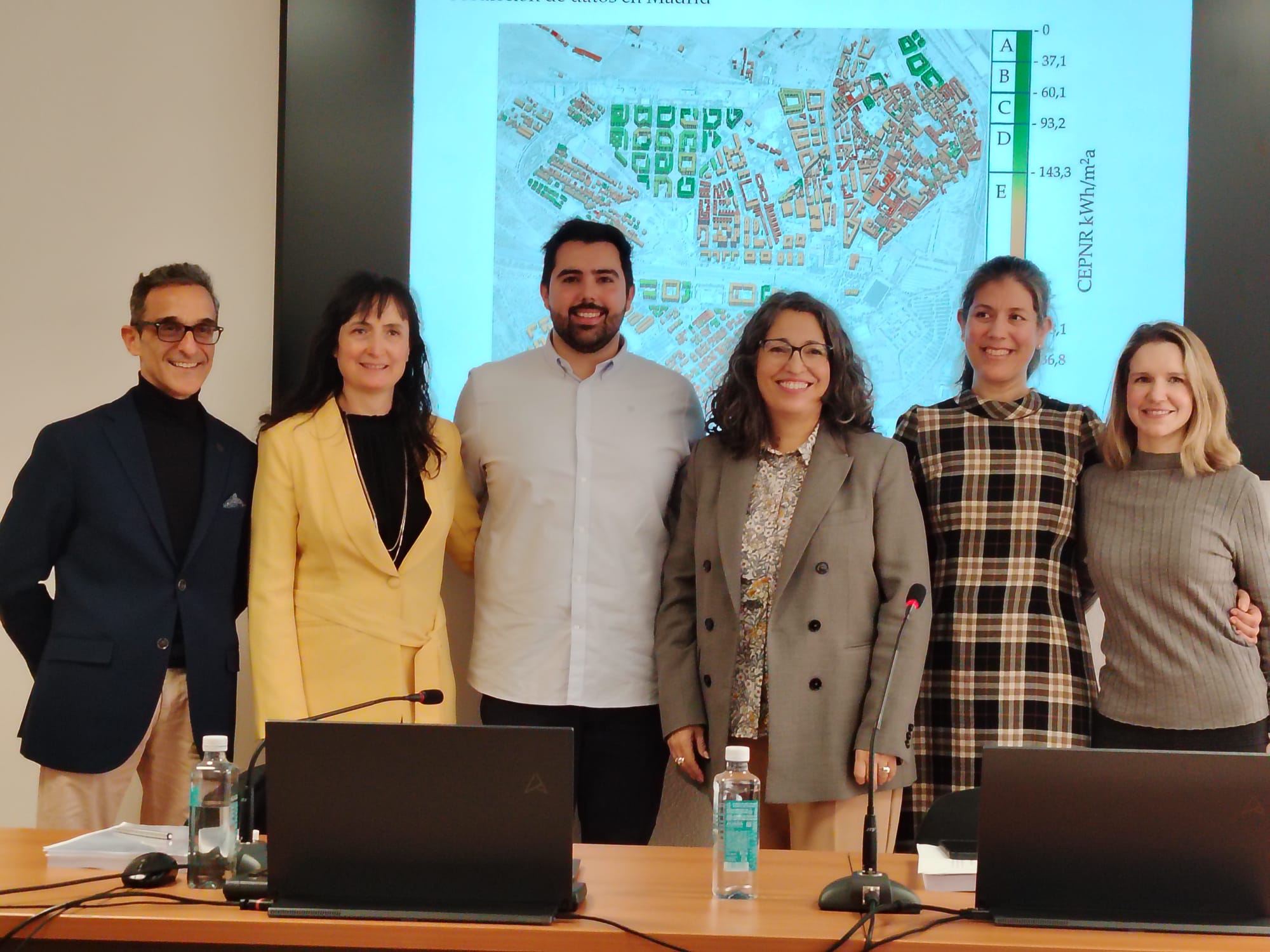
Carlos Beltrán Velamazán, researcher at the Built4Life Lab, supervised by Dr Belinda López-Mesa and Dr Marta Monzón-Chavarrías, defended today his PhD thesis entitled “Urban Building Energy Modelling Based on Open Data and AI for the Assessment of the European Building Stock: The Case of Spain” at the School of Engineering and Architecture of the University of Zaragoza. The examination committee comprised experts from the Universities of Seville (Dr Madelyn Marrero), Coimbra (Dr José Paulo de Almeida) and Zaragoza (Dr Raquel Trillo).
During his presentation, Beltrán introduced a highly innovative methodology capable of generating a fully automated national-scale UBEM (Urban Building Energy Model), making his work the third model of this scale developed worldwide. Its main breakthrough lies in its unprecedented computational efficiency: unlike the existing national models for the United States and Switzerland, the model developed in this thesis can run on a conventional computer, without requiring supercomputers or costly high-performance computing resources. Combined with its exclusive use of open data, this makes the model reproducible, scalable and accessible, with the ability to update automatically as new data become available.
The work is particularly relevant to the energy assessment of the Spanish building stock and has significant potential for supporting decarbonisation, building renovation and urban planning strategies. The examination committee highlighted the methodological quality of the research, the impact of its automated approach and the contribution of the Built4Life Lab to the UBEM field, which is moving towards faster, more open and more generalisable models.
With this development, Spain is positioned at the international forefront of large-scale urban building energy modelling, providing a valuable tool for addressing the challenges of the energy transition and improving energy efficiency in buildings.